TASK 1 (c)
BY JUN ZHANG, Translated by chatGPT
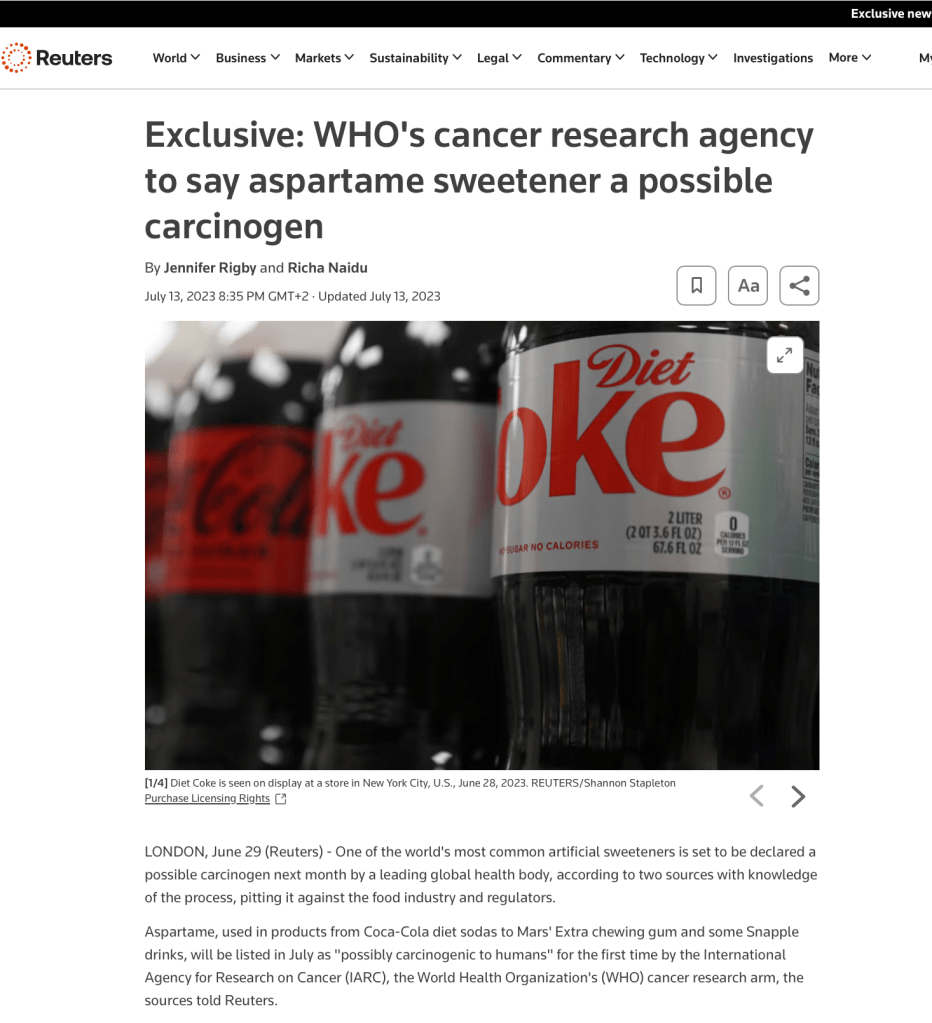
I selected the Reuters report on Aspartame being classified as “possibly carcinogenic” for this part of the task because it is a very representative example. It is not fake news, and it was not withdrawn. The event it reported, and the institutional judgement behind it, were both real. At the same time, the report could also easily lead the public to read a complicated scientific judgement as a direct health warning. This shows that the truthfulness of a report and its effect in public communication are not always exactly the same.
First, in terms of the 5Ws and 1H, the report is complete at the basic news level. Who is clear: the main institutions involved are IARC and JECFA within the WHO system. What is also clear: the main point of the report is that Aspartame was classified as “possibly carcinogenic.” When refers to the 2023 round of international risk assessment developments. Where is not a local physical setting, but a global news context involving consumers and the food market. Why the story matters is also obvious, because Aspartame is a widely used sweetener and is connected to the daily intake of many ordinary people. How the story is presented also follows a very typical Reuters structure: the most important information is put first, and then the background and explanation are added afterwards. From the point of view of news writing, the structure itself does not have a major problem, and readers can understand what the report is about.
However, the most important question is not whether the report explained the news event clearly, but whether it explained the scientific meaning clearly enough. If the focus is only on factual truth, the report does not have a major problem. Reuters was not relying on internet rumours or anonymous gossip. Its information came from IARC’s classification and from later formal explanation within the WHO system. In other words, the event basis of the report was real, and the institutional source was also real. For this reason, it cannot simply be called fake news. WHO’s later formal statement also confirmed that IARC did in fact classify Aspartame as Group 2B, or “possibly carcinogenic to humans.”
The real issue is whether the report placed that conclusion inside a complete enough explanatory framework. IARC was doing hazard identification, which means judging whether a substance may pose a carcinogenic hazard. But this is not the same thing as saying that actual intake in everyday life has been proven to reach a dangerous level. In the same statement, WHO also noted that JECFA kept the existing acceptable daily intake unchanged. This means that the two pieces of information should have been understood together: on one side, there may be a possible hazard; on the other side, the current intake standard had not changed. If readers only see the first part and do not really understand the second, then it becomes easy to read the report as saying that Aspartame has already been proven to be dangerous.
This is also why the report later received many professional responses. The main criticism was not that Reuters invented facts. The problem was that the headline and lead could easily create fear for ordinary readers. Reuters gave strongest visibility to the part of the story that was most likely to produce anxiety, while the equally important scientific distinction did not receive the same immediate clarity. After the Reuters report appeared, the UK Science Media Centre collected expert reactions. For example, Professor Amy Berrington from The Institute of Cancer Research pointed out that this kind of classification is not the same as a real-life risk assessment, and that the public could easily over-interpret the information. Later expert summaries also stressed that the evidence was limited and should not automatically be read as a clear everyday danger. At the same time, WHO’s formal statement also made clear that IARC’s work was hazard identification, while JECFA kept the acceptable daily intake unchanged. Seen in this way, the real issue is not whether Reuters reported a false event, but whether it explained clearly enough the most important difference between a possible hazard and actual intake risk in real life.
From the perspective of source verification, the basis of the Reuters report is actually strong. It relied on international institutional judgement and an authoritative framework, not on anonymous leaks or social media rumours. At the level of checking whether the source is real, the report stands up. But a real source does not mean the report has already completed all of its responsibility. For ordinary readers, the most important question is not only “who said this,” but also “how should this information be understood.” The difficulty with the Reuters report is exactly here. It had authoritative sources, but it placed the part most likely to produce an emotional reaction at the front, while the part that required slower public understanding came later.
For this reason, the possible agenda of the report is not political, and it is not conspiratorial. More accurately, it reflects a very typical news framing, and it also shows a strong headline-led tendency. News organisations need to deliver an important public message quickly and clearly, so a phrase such as “possibly carcinogenic,” which is highly noticeable and easy to circulate, is naturally given prominence. This writing choice is understandable in news logic because it fits timeliness and communication efficiency. But in science communication, it can also create an obvious side effect: what the public receives first is a risk signal, not the full background. That is why this report is a useful example for discussing the responsibility boundaries of health reporting in the digital news environment.
Overall, this Reuters report does not have a major problem in terms of event truthfulness or source authority, so it should not be simply classified as false reporting or fake news. The problem appears at the level of communication. It compressed a scientific issue that required careful distinction into a public message that was more likely to create anxiety. In other words, the report was true, but its explanation was not fully sufficient; its source was authoritative, but its framing could still mislead the public. That is exactly why it is such a useful case. It shows that in digital journalism, “truthfulness” does not depend only on whether the facts are real, but also on whether the media explains those facts in a way that ordinary readers will not easily misunderstand.


Leave a Reply