Research TWO digital media news reports
TASK 1 (a)
BY JUN ZHANG, Translated by chatGPT
For this task, I selected two news reports about sports technology and public health. I chose these two reports because both topics are close to my daily life, and I already pay attention to them in my normal reading.
Report 1: How revolutionary shoe tech is changing the running game
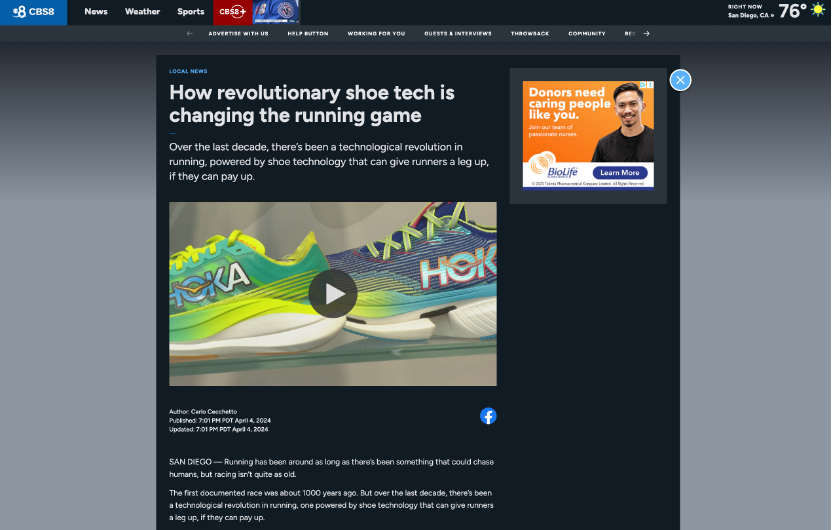
CBS 8, April 2024
I chose this report because I am a person who pays a lot of attention to sports gear. I often read news about how equipment can affect sports safety and performance. I found this report when I was searching for information before choosing running shoes for myself. It is a local report, and it was not widely reposted, but it still caught my attention.
What interested me was not only the shoes themselves. I was more interested in the bigger question behind the report. If high-tech shoes can really help runners improve their results, then is competition still mainly decided by training and physical ability? This is why I think this report is worth analysing. I would classify it as informative.
Report 2: Exclusive: WHO’s cancer research agency to say aspartame sweetener a possible carcinogen
REUTERS, July 13, 2023
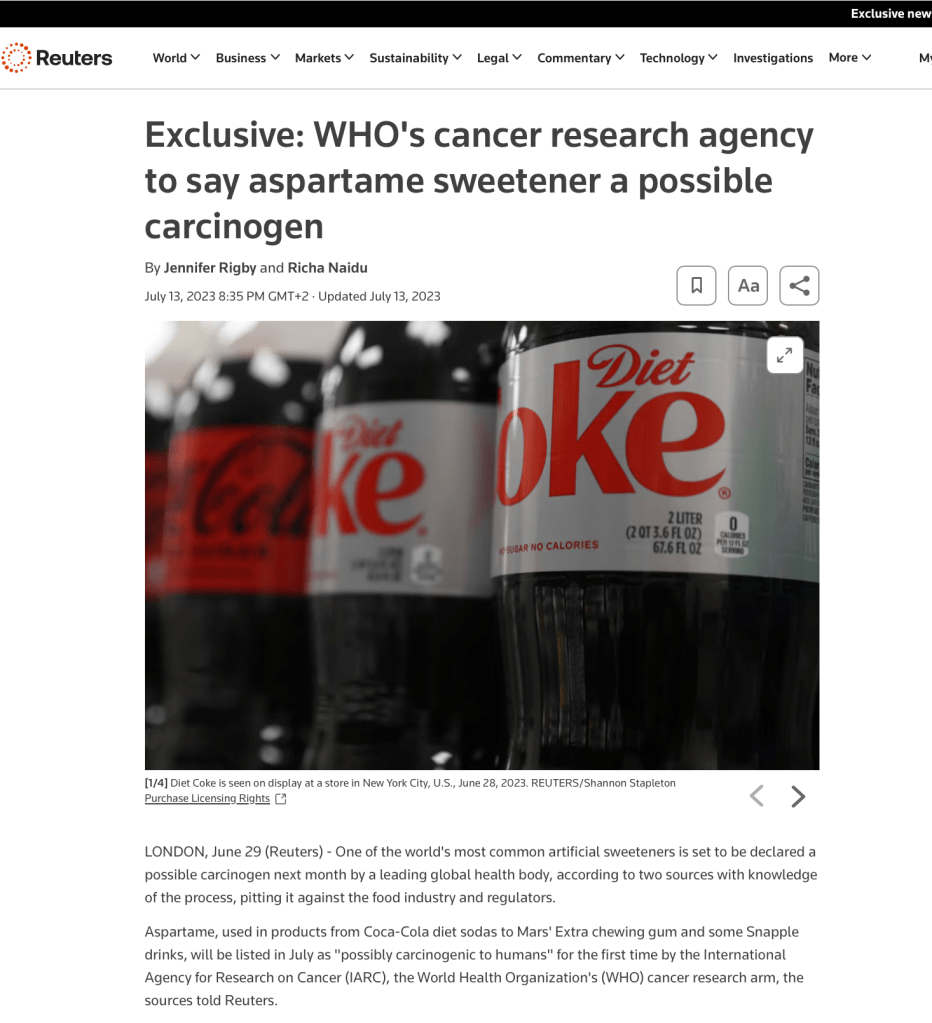
I chose this Reuters report because the topic is related to my own life. Many years ago, I took a genetic test and found that my risk of Type 2 diabetes was relatively high. Because of this, I have paid attention to sugar intake for many years. I also pay attention to sweeteners and sugar substitutes.
When the media started reporting that Aspartame was “possibly carcinogenic,” I immediately looked for more related information. What interested me in this report was not only the headline itself. I was more concerned with whether the media had explained this health issue clearly enough. I think this report is useful because it can help me discuss how digital media reports complicated health risks to the public. I also classify this report as informative.
Why I chose these two reports together
I put these two reports together because, although they are from different fields, both of them are connected to the human body. The first one is about how technology may influence sports performance. The second one is about how media reports possible health risks. For me, these two topics are not far away from my own life. They are both related to my own observations and concerns. Because of this, I think they are suitable for my Task 1 analysis.
Comparative Analysis of Chosen News Reports
TASK 1 (b)
BY JUN ZHANG, Translated by chatGPT
Report 1: How revolutionary shoe tech is changing the running game
Source: CBS 8, April 2024
1. Narrative Construction
The report follows a clear linear structure. It opens with a broad historical reference to running as an old sport, then shifts quickly to the recent technological transformation of running shoes. From there, the story moves from product explanation to lived experience and finally to a wider fairness debate. The progression from background, to technology, to performance, to ethics gives the piece a coherent narrative shape and makes the issue accessible to a general audience.
2. Treatment
The report is treated as a local digital feature rather than a hard-news confrontation piece. Its tone is relatively light and accessible, but it does not avoid the underlying controversy. The use of the phrase “cheat code” is especially effective because it translates a technical advantage into everyday language while also introducing an ethical undertone. This allows the story to remain audience-friendly without becoming purely promotional.
3. Quality and Depth of Subject Matter
The subject matter is relevant and timely, particularly because it connects elite sports technology with ordinary runners and younger competitors. The report does more than introduce a new product; it raises questions about cost, access and competitive fairness. Its main limitation is depth. The issue is identified clearly, but not fully developed through regulatory detail, scientific evidence or broader comparative context. As a result, the piece functions well as an explanatory report, but not as a deep investigation.
4. The Role of the Presenter / Interviewer
The reporter functions primarily as a facilitator. Rather than dominating the story, he builds the framework through voice-over, transitions and selective questioning. This role is consistent with the format of local digital television news, where clarity and flow often take priority over adversarial interviewing. The presenter’s main contribution is to organise the issue into a discussion that viewers can follow easily.
5. The Interviewee as a Character in the Story
The interviewees are used strategically and each one represents a different dimension of the topic. The store owner speaks from the point of view of product knowledge and consumer demand. The recreational runner provides embodied experience, making the effects of the shoes feel immediate and concrete. The coach introduces a more serious perspective by shifting the focus from personal benefit to structural fairness, especially in relation to younger athletes and future opportunities. This division of roles gives the story more balance than a simple product-centred report.
6. Technical Elements
As a television-style digital report, the story appears to rely on a conventional combination of voice-over, interview clips and supporting visuals. In this case, close-up shots of the shoes, running footage and training scenes are not just decorative; they are central to explaining the subject. The visual material helps translate an abstract technological argument into something physically visible. The editing is likely straightforward rather than stylised, which suits the explanatory purpose of the piece.
7. Cultural Context
The report reflects a broader cultural shift in sport, where performance is increasingly connected to technology, equipment and purchasing power. In that sense, the issue is not limited to running shoes. It points to a larger question within contemporary sport: whether access to better products is beginning to influence outcomes that are still publicly presented as merit-based. The piece therefore sits at the intersection of sport, consumer culture and inequality.
8. The Presenter’s Intentions of Telling the Story
The report appears designed to do more than showcase an innovation in sports gear. Its underlying purpose is to raise a question about the changing meaning of competition. By presenting the shoes as both effective and potentially controversial, the story invites discussion about where normal technological progress ends and unfair advantage begins. The report does not force a conclusion, but it clearly frames the issue as one that deserves public attention.
Report 2: Reuters report on Aspartame being classified as “possibly carcinogenic”
Source: Reuters, 2023
1. Narrative Construction
The report follows a standard international news agency structure, placing the most important information first. Its central claim is that IARC, the cancer research arm of the WHO, was preparing to classify Aspartame as “possibly carcinogenic.” After presenting this key point, the report moves on to background explanation, including the source of the classification and why it may affect both consumers and the food industry. Reuters first reported the classification in advance and later followed with more explanatory coverage, which is consistent with the agency’s approach to major public-interest news.
2. Treatment
The report maintains Reuters’ usual serious and concise style, with high information density and a fast pace. On the surface, the language remains measured. However, the phrase “possibly carcinogenic” carries strong emotional weight once it enters public news circulation. Even without exaggerated wording, such phrasing can still create public anxiety before readers fully understand the scientific context. In this sense, the report is formally restrained, but its likely reception is more unstable.
3. Quality and Depth of Subject Matter
The subject itself is highly important because Aspartame is a widely used sweetener that relates directly to everyday consumption. From a news perspective, the story has clear public-health value. Its strength lies in identifying an important regulatory and scientific development at the right moment. Its difficulty lies in explanation. The distinction between hazard classification and actual consumption risk is not easy for a general audience to understand. WHO’s later statement made this distinction explicit: while IARC classified Aspartame as Group 2B, JECFA maintained the existing acceptable daily intake. This means the report captured an important issue, but the part most visible to readers was also the part most open to misunderstanding.
4. The Role of the Presenter / Interviewer
This report does not rely on a visible presenter or on-camera interviewer. Instead, the journalist’s role is embedded in the selection, ordering and framing of information. In this type of text-based digital news, journalistic presence is less visible but still significant. The report’s authority depends not on performance, but on how information is prioritised and contextualised.
5. The Interviewee as a Character in the Story
Unlike the CBS 8 report, this Reuters piece is not driven by individual human characters. Its central voices are institutions and expert sources rather than personal stories. WHO, IARC and JECFA function as the main authoritative actors, while expert interpretation provides secondary context. This strengthens the report’s formal credibility, but it also makes it easier for readers to receive the classification as a simplified conclusion rather than as part of a more layered scientific discussion.
6. Technical Elements
Because this is mainly a text-based digital report, the technical elements are different from those of a video package. The most important elements here are the headline, the lead and the order of information. The phrase “possibly carcinogenic” is given immediate prominence, which shapes the reader’s first impression before the explanatory background appears. In this case, framing is achieved not through visuals or sound, but through textual emphasis and sequencing. That is where much of the report’s digital impact lies.
7. Cultural Context
The report sits within a broader culture of public sensitivity to food safety, cancer risk and long-term health effects. In a digital environment where many readers form opinions quickly from headlines and short summaries, words such as “carcinogenic” carry exceptional force. Scientific terminology, once transferred into mass media, often changes meaning in practice because the public reads it through fear, habit and prior assumptions. This helps explain why reports of this kind so often generate professional debate.
8. The Presenter’s Intentions of Telling the Story
The report’s immediate purpose is consistent with standard journalism: to deliver an important public-health development quickly and clearly. From a news perspective, that intention is understandable. At the same time, the piece also exposes a recurring tension in health reporting. Journalism values speed, clarity and impact, while science often depends on qualification, background and careful distinctions. As a result, the report succeeds in reporting a major development, but it also demonstrates how easily complex scientific information can be compressed into a simplified public message.
Liability and Authenticity Analysis of the Reuters Aspartame Report
TASK 1 (c)
BY JUN ZHANG, Translated by chatGPT
I selected the Reuters report on Aspartame being classified as “possibly carcinogenic” for this part of the task because it is a very representative example. It is not fake news, and it was not withdrawn. The event it reported, and the institutional judgement behind it, were both real. At the same time, the report could also easily lead the public to read a complicated scientific judgement as a direct health warning. This shows that the truthfulness of a report and its effect in public communication are not always exactly the same.
First, in terms of the 5Ws and 1H, the report is complete at the basic news level. Who is clear: the main institutions involved are IARC and JECFA within the WHO system. What is also clear: the main point of the report is that Aspartame was classified as “possibly carcinogenic.” When refers to the 2023 round of international risk assessment developments. Where is not a local physical setting, but a global news context involving consumers and the food market. Why the story matters is also obvious, because Aspartame is a widely used sweetener and is connected to the daily intake of many ordinary people. How the story is presented also follows a very typical Reuters structure: the most important information is put first, and then the background and explanation are added afterwards. From the point of view of news writing, the structure itself does not have a major problem, and readers can understand what the report is about.
However, the most important question is not whether the report explained the news event clearly, but whether it explained the scientific meaning clearly enough. If the focus is only on factual truth, the report does not have a major problem. Reuters was not relying on internet rumours or anonymous gossip. Its information came from IARC’s classification and from later formal explanation within the WHO system. In other words, the event basis of the report was real, and the institutional source was also real. For this reason, it cannot simply be called fake news. WHO’s later formal statement also confirmed that IARC did in fact classify Aspartame as Group 2B, or “possibly carcinogenic to humans.”
The real issue is whether the report placed that conclusion inside a complete enough explanatory framework. IARC was doing hazard identification, which means judging whether a substance may pose a carcinogenic hazard. But this is not the same thing as saying that actual intake in everyday life has been proven to reach a dangerous level. In the same statement, WHO also noted that JECFA kept the existing acceptable daily intake unchanged. This means that the two pieces of information should have been understood together: on one side, there may be a possible hazard; on the other side, the current intake standard had not changed. If readers only see the first part and do not really understand the second, then it becomes easy to read the report as saying that Aspartame has already been proven to be dangerous.
This is also why the report later received many professional responses. The main criticism was not that Reuters invented facts. The problem was that the headline and lead could easily create fear for ordinary readers. Reuters gave strongest visibility to the part of the story that was most likely to produce anxiety, while the equally important scientific distinction did not receive the same immediate clarity. After the Reuters report appeared, the UK Science Media Centre collected expert reactions. For example, Professor Amy Berrington from The Institute of Cancer Research pointed out that this kind of classification is not the same as a real-life risk assessment, and that the public could easily over-interpret the information. Later expert summaries also stressed that the evidence was limited and should not automatically be read as a clear everyday danger. At the same time, WHO’s formal statement also made clear that IARC’s work was hazard identification, while JECFA kept the acceptable daily intake unchanged. Seen in this way, the real issue is not whether Reuters reported a false event, but whether it explained clearly enough the most important difference between a possible hazard and actual intake risk in real life.
From the perspective of source verification, the basis of the Reuters report is actually strong. It relied on international institutional judgement and an authoritative framework, not on anonymous leaks or social media rumours. At the level of checking whether the source is real, the report stands up. But a real source does not mean the report has already completed all of its responsibility. For ordinary readers, the most important question is not only “who said this,” but also “how should this information be understood.” The difficulty with the Reuters report is exactly here. It had authoritative sources, but it placed the part most likely to produce an emotional reaction at the front, while the part that required slower public understanding came later.
For this reason, the possible agenda of the report is not political, and it is not conspiratorial. More accurately, it reflects a very typical news framing, and it also shows a strong headline-led tendency. News organisations need to deliver an important public message quickly and clearly, so a phrase such as “possibly carcinogenic,” which is highly noticeable and easy to circulate, is naturally given prominence. This writing choice is understandable in news logic because it fits timeliness and communication efficiency. But in science communication, it can also create an obvious side effect: what the public receives first is a risk signal, not the full background. That is why this report is a useful example for discussing the responsibility boundaries of health reporting in the digital news environment.
Overall, this Reuters report does not have a major problem in terms of event truthfulness or source authority, so it should not be simply classified as false reporting or fake news. The problem appears at the level of communication. It compressed a scientific issue that required careful distinction into a public message that was more likely to create anxiety. In other words, the report was true, but its explanation was not fully sufficient; its source was authoritative, but its framing could still mislead the public. That is exactly why it is such a useful case. It shows that in digital journalism, “truthfulness” does not depend only on whether the facts are real, but also on whether the media explains those facts in a way that ordinary readers will not easily misunderstand.


Leave a Reply