Course: BA (Hons) Journalism
Subject: General and Constitutional Knowledge
Student Name: JUN ZHANG
Date of Submission: 5 May 2026
1. Research Focus & Interdisciplinary Context
Note on Continuous Investigative Reporting
This research continues the issue of “difficulty in social integration” that I first identified in the “reporting for the digital media” course. The earlier work mainly focused on describing the social signs of this problem. In Task 2, I take the investigation further by looking at it through a constitutional and legal lens, in order to examine the institutional deadlock behind it. This cross-disciplinary approach reflects a journalistic effort to follow one social issue in Malta across different systems and structures.
Core Argument
This research argues that although Article 5 of the Constitution of Malta gives the Maltese language an important constitutional position, the implementation of L.N. 419/2017 is weakened by restrictive administrative barriers and an assessment system that is disconnected from real language use. As a result, the law has limited practical effect in supporting social integration, even though its wider constitutional purpose is to protect the national language and promote social cohesion.
2. Historical and Constitutional Background (KU 1.1, 1.2, 1.3)
The recognition of Maltese as the national language in the 1964 Constitution was the result of the long “Language Question” in Malta, which lasted for more than a century.
A Symbol of Class and Power
In the nineteenth century, Italian was the language of the law, the Church, and the educated elite, while English represented colonial administrative power. During this period, Maltese was largely marginalised and was mainly treated as the language of ordinary people (Frendo, 1991).
The Keenan Report (1880)
In his report, British colonial official Patrick J. Keenan recommended that English should replace Italian in the education system. This was not only an educational proposal, but also a political move to reduce the influence of the pro-Italian elite through language policy (Keenan, 1880).
Wartime Turning Point and Constitutional Status
With the outbreak of the Second World War, the political position of Italian collapsed because Italy and Malta, then a British colony, were on opposing sides. In 1934, Italian lost its status as an official language, and Maltese took its place (Hull, 1993). This historical shift later shaped Article 5 of the 1964 Constitution, which officially recognised Maltese as the national language and made it a core symbol of national identity and sovereignty (Constitution of Malta, 1964).
The constitutional status of Maltese should therefore not be seen as only symbolic. It should also be reflected in real institutions and policies that support social integration, public participation, and national cohesion.
3. Systemic Disconnect in Legal Framework and Administrative Execution (KU 2.3, 3.1)
From the point of view of constitutional practice, Article 5 gives Maltese the status of national language, but constitutional principles do not become social reality by themselves. They need to be carried out through the coordinated work of public institutions and government bodies. The Maltese judiciary itself explains that the State is built on three main pillars: the Legislature, the Executive, and the Judiciary. This means that constitutional principles must pass through institutions before they can shape everyday life.
In structural terms, these policies are not carried out by one single department. They are spread across different bodies, including the “I Belong” programme under the Ministry for Home Affairs, Lifelong Learning courses under the Ministry for Education, and the Jobsplus system linked to employment and training. Although L.N. 419/2017 provides a legal framework for integration services, the way these services work in practice often moves away from the spirit of the Constitution.
Administrative Deadlock in Educational Resources
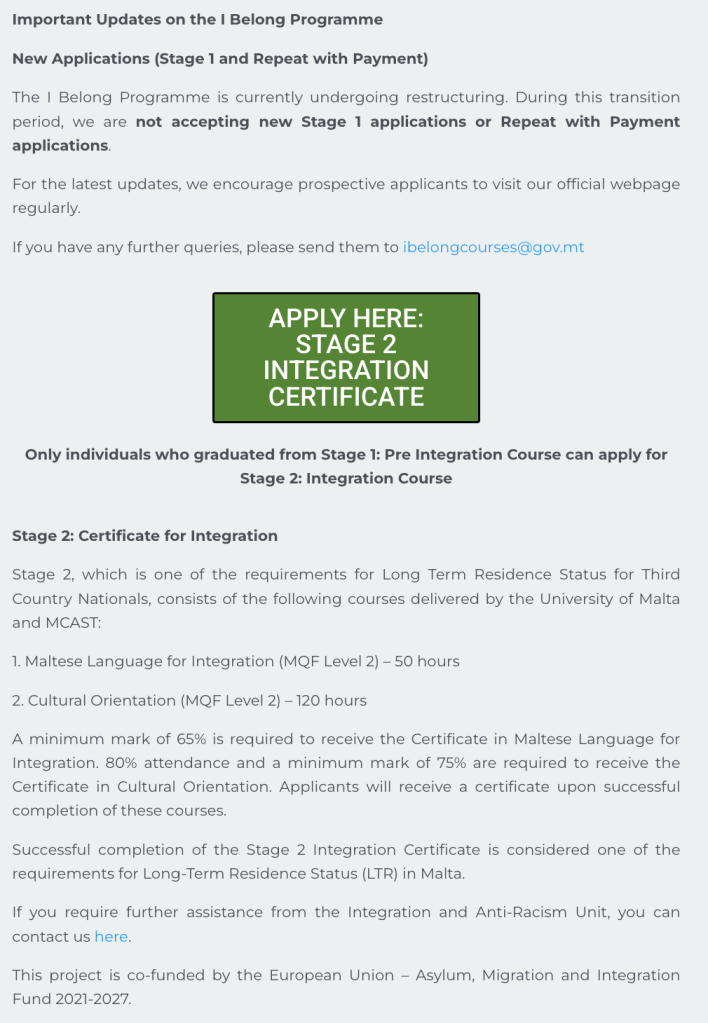
The “I Belong” programme and Lifelong Learning courses both offer Maltese language classes in theory. In practice, however, access is difficult. Entry points are unstable, places are limited, and the process can be hard to follow. This makes it difficult for the right to integration to work in real life.
Restrictive Access Through Employment Structures
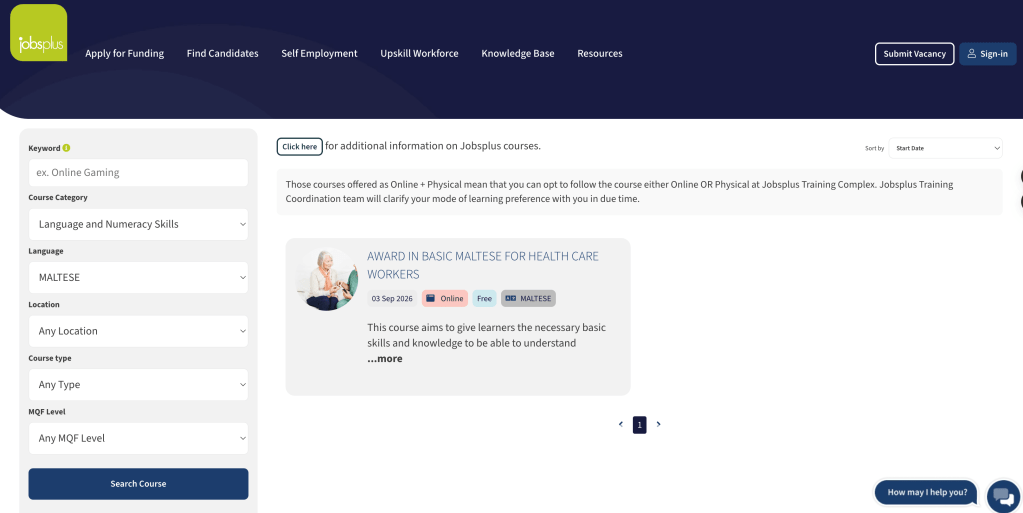
Research shows that Maltese language learning resources on the Jobsplus platform are often limited to certain job categories or types of workers. This makes equal access harder for other foreign workers. It also turns language learning into a tool for filling labour shortages rather than treating it as a general integration resource, which goes against the wider public purpose of integration services under L.N. 419/2017.
Disconnect Between Assessment and Real Language Use
The MQF 1 and TCA 1 Maltese language exams for foreigners also show a clear gap between policy and reality. Based on interviews with frontline teachers, the design of these exams does not match the way Maltese is actually used in daily life. This suggests that the system is not always built around real integration, but around showing formal compliance.
4. Investigative Evidence and Fact-Checking (AA 3.1, 3.2)
Verification of the Legal Notice
By consulting the Leġiżlazzjoni Malta database, it can be confirmed that the Malta Foreigners (Service of Integration) Regulations, namely L.N. 419 of 2017, is one of the key legal frameworks regulating integration services for foreigners.
Empirical Investigative Evidence
Evidence A:
The screenshot from the official “I Belong” website in the appendix shows that the application portal is not continuously open. This suggests that even where a legal framework exists, the actual point of access to the service may still be unstable or unavailable.
Evidence B:
The screenshot from Jobsplus in the appendix shows that language learning resources are distributed in ways that favour certain occupations. This suggests that language training is not fully treated as a general integration resource, but is instead used in a more limited and practical way.
Parliamentary Debates
Besides administrative evidence, this research also refers to the parliamentary discussion on Integration and Socialization of Migrants held on 16 February 2022. In that discussion, Samuel Nweze, a representative of OPAD, argued that society should “think about real integration, not just talking about integration, but actually implementing integration.” This statement directly supports the central finding of this research: integration is often stressed in policy language and public discussion, but there is still a clear gap at the level of implementation.
At the same discussion, Msida Mayor Margaret Baldacchino Cefai described socialisation as a “two-way process” that requires both immigrants and the host community to understand and adapt to each other’s norms and values. However, the institutional reality identified in this research, including unstable access to courses and job-based limits on language resources, looks far more like a one-way administrative filter than a two-way process of integration.
Speaker of the House Dr Anġlu Farrugia also noted that Europe and Malta will continue to face ageing populations and labour shortages, and will therefore remain dependent on migrant workers. This highlights a deeper structural contradiction: the State needs migrants economically, but has not built enough public support to make long-term integration work in practice.
Case Law and Judicial Principles
At the judicial level, Malta has a clear legal basis for reviewing administrative action. Article 469A of the Code of Organization and Civil Procedure confirms that certain administrative acts can be challenged through judicial review. This shows that administrative bodies are not above legal scrutiny when they make decisions that affect individual rights.
In addition, a case analysis published by the Aditus Foundation makes clear, even in its title, that when Identity Malta refuses an application on the ground of “public security,” that refusal “must be based on evidence,” and that the Immigration Appeals Board is bound by the principle of equality of arms. This assignment does not go into the full details of that case, but the public title of the analysis is already enough to show that Maltese legal discussion pays close attention to evidence and procedural fairness in administrative decisions.
Research Conclusion
Taken together, the evidence above, along with teacher interviews, public parliamentary discussion, and judicial principles, shows that there are serious gaps and institutional inconsistencies in the way administrative bodies carry out the language and social integration goals connected to Article 5 of the Constitution.
5. References
Aditus Foundation (n.d.) Civil Court: Refusals by Identity Malta on basis of public security must be based on evidence, Immigration Appeals Board is bound by principle of equality at arms – analysis. Available at: https://aditus.org.mt/civil-court-refusals-by-identity-malta-on-basis-of-public-security-must-be-based-on-evidence-immigration-appeals-board-is-bound-by-principle-of-equality-at-arms-analysis/ (Accessed: 3 May 2026).
Code of Organization and Civil Procedure (Malta) (2026) Article 469A. Available at: https://legislation.mt/eli/cap/12/eng/pdf (Accessed: 3 May 2026).
Constitution of Malta (1964) Constitution of Malta. Valletta: Government Printing Press.
Frendo, H. (1991) Party Politics in a Fortress Colony: The Maltese Experience. Malta: Midsea Books.
Hull, G. (1993) The Malta Language Question: A Case Study in Cultural Imperialism. Malta: Said Reforms.
Judiciary Malta (n.d.) The Judiciary. Available at: https://judiciary.mt/en/the-judiciary/ (Accessed: 3 May 2026).
Keenan, P.J. (1880) Report upon the Educational System of Malta. London: Colonial Office.
Leġiżlazzjoni Malta (2017) Malta Foreigners (Service of Integration) Regulations. Available at: https://legislation.mt/eli/ln/419/2017/eng (Accessed: 3 May 2026).
Parliament of Malta (2022) Integration and Socialization of Migrants. Available at: https://www.parlament.mt/13th-leg/political-groups/speaker-farrugia-anglu/activities/integration-and-socialization-of-migrants/ (Accessed: 3 May 2026).


Leave a Reply